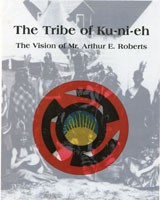
Ku-ni-eh
was founded in Cincinnati, OH. by Arthur Roberts, Scout Executive in 1923.
Roberts was a charismatic and inspirational leader, Scout Executive in
Cincinnati for twenty nine years. Roberts had a difficult childhood, running
away from home as a youth and making his way in the world. It was a popular
theme in that era of the self made man, pulling himself up by his boot
straps, Roberts personified that theme.
His lack of formal education didn’t
handicap him, he authored books on youth and interacted with influential
people of Cincinnati. Like other beloved pioneer Scout Executives he was
affectionately known as The Chief. Thanks David Madison for the research on
Roberts.
The name Ku-ni-eh is taken from the Native American Maidu Tribe of
California. Ku-ni-eh means “Order of Manhood”. The symbol was the
We-Hin-Ah-Pay”, the rising sun. Roberts developed a printed manual as early
as 1923. A professionally printed Ceremonial Book was published in 1926.
Much of this history is lost and discovery is so much fun. I learned that
Ku-ni-eh was brought to Milwaukee in the 1930’s by the Chairman of the
Council Executive Board, Edgar Friedlander, Jr. The Cincinnati Camp was
named for his father. Ku-ni-eh was confirmed in Mahoning Valley, OH. when a
scout shirt from Youngstown was found with a Ku-ni-eh badge on it. Years
ago, I developed a list of 16 councils that used Ku-ni-eh. Dave Eby with the
USSP web-site now has now identified 22 places where Ku-Ni-Eh was used. |
|
|
Ohio
Cincinati
Sandusky
Youngstown |
Kentucky
Lexington
Paducah
Pikeville
Louisville
Newport |
Texas
Texarkana
San Angelo
Brownwood
Waco
Wichita Falls |
South Carolina
Greenville
Palmetto
Spartanburg |
North Carolina
Wilmington
Goldsboro |
Wisconson
Janesville
Milwauikee
Waukesha
|
AS KNOWN 2/2021
cities are shown because some councils changed. |
|
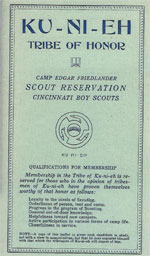 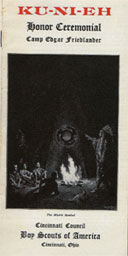
In 1924 at the 4th Bi Annual Training Meeting, there was discussion about
camp fraternities. They were nearly disapproved and scouting professionals
were instructed to keep groups local. Even though the WWW met in 1921 with
plans for growth. Ku-ni-eh had quality printed material so early that they
had an advantage over other groups. It doesn’t appear that Ku-in-eh had a
plan for a national organization. Others were welcome to Ku-ni-eh printed
material and there were no charter fees. A council in South Carolina or Texas could send to Cincinnati for booklets to start a Ku-ni-eh tribe.
If
they modified something there was no governing body to approve or disapprove
and most important to some Scouting professionals, there were no National
dues, or charter fees.
To the left - 1923 Brochure To the right - 1926 Brochure |
|
|
The Ku-ni-eh organization and ceremonial is exceptional. There is no
explanation where Roberts got the inspiration for such a group or ceremony.
In David Madison’s book, The Tribe of Ku-ni-eh, a Native American, Charles
Eastman is mentioned. Eastman is a Native American and authored a book
Indian Scout Talks. It’s possible that Roberts got some of the ideas for
Ku-ni-eh from this book.
Ku-ni-eh Candidates were chosen by camp staff members. This was a common way
of selecting method. In many groups the candidate had to meet certain
requirements before becoming eligible for higher honors. In Nani-Ba-Zhu the
candidate had to have qualified as a Black Diamond. In White Swastica
(Portsmouth) the candidate had to be a Motawk. In many WWW lodges the
candidate had to be a Honor Camper, having passed achievement test, before
being eligible for election into the lodge. At the time of selection all
Ku-ni-eh members present had to unanimously approve the candidate, again
that is different from modern ways, but common for the early years. |
|
|
|
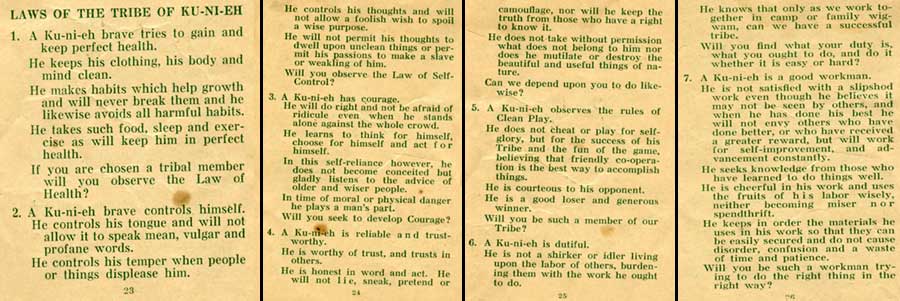
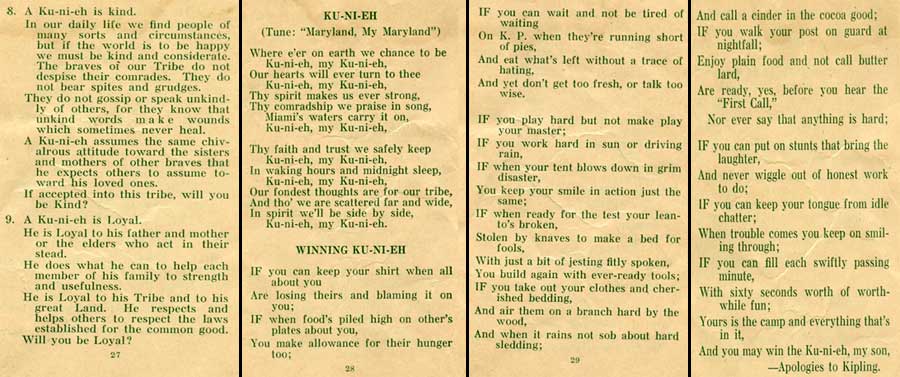
This is what a 1920's Camp booklet says about Ku-ni-ch |
|
|
 |
 |
|
|
|
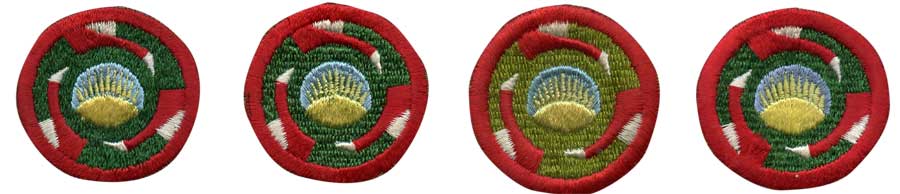
Cincinnati Ku-ni-eh Insignia |
|
|
 |
|
Minor varieties of Ku-ni-eh badges on full 2 1/4” square khaki square cloth. All
have 11 sun rays. These exist on tan to khaki cloth. |
|
|
 |
|
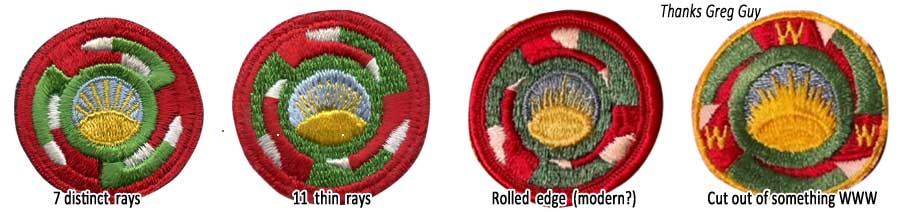
The two to the left appear to be punched, not cut out of background cloth.
Probably not from Cincinnati. |
|
|
Ku-ni-eh badges were available from Lion Brothers embroidery in lots of 25 as
early as 1926. Smaller quantities could be bought from the Cincinnati Scout
office. The Cincinnati tribe had a large membership and existed for many years.
Collectors will find many Ku-ni-eh patches cut to round and often laundered. I
do not use worn badges to document varieties.
In 1951 Scout Executive Art Roberts retired after an exemplarily professional
career. The new Executive, Frank Braden had a strong OA background, Lodge 50
Alabama and Lodge 70, North Carolina. The new Cincinnati OA lodge chose Ku-ni-eh
as their name and the We-Hin-Ah-Pay as their totem.
|
 |
|
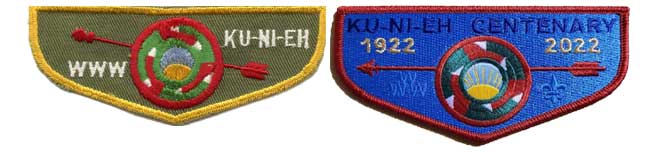
When Cincinnati became OA, the rising son was adopted as their totem. This totem
appears on almost all of their modern badges. |
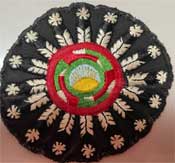
The issue to the left is in the Greg Guy collection. It’s believes to be a dance
team issue from an Indian dance Explorer Post in Indiana. |
 |
|
|
Paul Myers Goshen,
Indiana
gimogash@comcast.net |
